
Dominican Republic Pensioner Residence
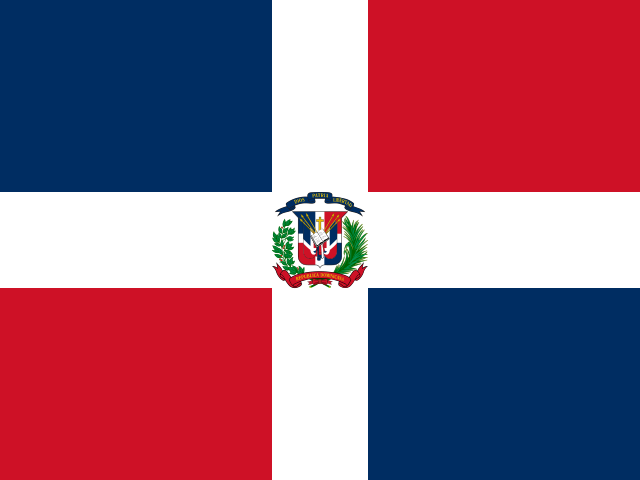 Dominican Republic
Residency
Dominican Republic
Residency
At a glance
This Law 171-07 route is for a person receiving at least USD $1,500 each month from a foreign government, official body, or private-company pension, plus USD $250 for each dependent included. There is no minimum age, but salary and savings alone do not meet the pension test.
- Type
- Law 171-07 pensioner residence
- Minimum pension
- USD $1,500 monthly plus USD $250 per dependent
- Minimum age
- None
- Work
- Law 171-07 permits paid work, with Dominican tax due on the salary
- Minimum monthly income
- A pension of USD $1,500 per month, plus USD $250 per dependent
- Savings option
- No
Summary
Pensionado is the Dominican residence route under Law 171-07 for a person receiving a qualifying foreign pension of at least USD $1,500 per month. The principal applicant must add USD $250 per month for each dependent included. There is no minimum age.
The pension must be paid by a foreign government, official body, or private company and must be documented as a pension or retirement benefit. DGM expressly says salary does not count. A large retirement-account balance, planned withdrawals, or current wages are therefore not automatic substitutes for the required certified pension.
Regulation 631-11 places qualifying pensioners in the permanent-resident category through the investment-residence window. The current DGM service page nevertheless describes the residence card as valid for one year, and the current renewal service is annual. “Permanent” describes the immigration category; it does not mean the physical card never expires or that the income evidence can be abandoned.
Eligibility
The principal applicant needs at least USD $1,500 each month from the qualifying foreign pension source. For example, a filing with a spouse and one qualifying child needs at least USD $2,000 per month: the USD $1,500 base plus USD $250 for each of two dependents.
Law 171-07 and the DGM checklist accept a pension from:
- a foreign government;
- a foreign official or public body; or
- a foreign private company for which the applicant worked.
The provider’s certification should identify the applicant, the time in the organization, the position held, and the monthly pension amount. It must complete the authentication and Spanish-translation steps required for its country of issue. Social Security or a military retirement benefit can fit when the responsible government agency issues the necessary certification. A private pension can fit when the former employer or responsible plan source can provide the required evidence.
The official sources do not impose a general “lifetime guaranteed” phrase as a separate statutory test. They do require an actual monthly pension and satisfactory proof. An annuity or retirement-account distribution that does not fit the government, official-body, or former-employer pension definition should not be promised as qualifying; ask DGM before relying on it.
Dependents
Law 171-07 allows the principal applicant to include:
- a spouse;
- unmarried children under 18;
- adult children who are disabled;
- adult children who prove they are university students and financially dependent; and
- minors under the legally recognized guardianship of the principal applicant or spouse.
Each included dependent adds USD $250 to the monthly-income requirement and needs the applicable civil, passport, visa, criminal-record, and guarantee documents. The current DGM page says a child older than 18 can be included only when financially dependent because of study or disability.
Residence and document file
The filing begins with the MIREX Residence Visa (RS) for pension/retirement. At DGM, the current checklist includes the passport, RS visa, birth and civil-status records, foreign criminal record, DGM medical examination, pension certification, migration guarantee policy covering dependents, and a letter showing a Dominican bank account. DGM can request other records to verify the claimed pensioner status.
The initial residence card is valid for one year. Renewal requires a Dominican criminal record, the expired/current card and cédula records, and evidence that the pension was received in Dominican territory during the prior permit period. Use the live renewal page for timing and fees.
Law 171-07 benefits
Law 171-07 provides benefits after the pensioner’s residence is approved and the separate agency conditions are met. They include an income-tax exemption for the amount declared to qualify under the law; possible household-goods customs relief under Law 14-93; partial vehicle-tax relief under the referenced vehicle law; an exemption on transfer taxes for the first acquired property; and specified 50% reductions for certain property, mortgage, and capital-gain taxes.
These benefits are not automatic discounts at a closing or port. Each one has conditions, documentation, agency procedures, limits, and possible later tax consequences. For example, household-goods relief is limited to the approved principal applicant under the statutory language, and benefited goods or vehicles cannot simply be resold free of the ordinary taxes.
What This Route Allows
An approved pensionado can reside in the Dominican Republic in the Law 171-07 permanent category and include the qualifying dependents listed above. The resident can renew while the pension and other program conditions continue.
Contrary to common “retirement visa” summaries, Law 171-07 expressly permits pensioners and rentistas to perform paid work in the country. Salary from that work is taxable in the same way as the salary of a Dominican employee. Separate professional licensing, employment, social-security, and business rules still apply.
After more than two years of qualifying permanent residence, a pensionado may explore ordinary naturalization under the current MIP criteria. Residence does not guarantee citizenship, and the naturalization file and government decision remain separate.
What This Route Is Not
This is not a savings-based visa. A bank balance, 401(k), IRA, brokerage account, or plan to sell investments does not replace the certified pension source. Rentista is the separate Law 171-07 category for certain investment or property income.
It is not restricted to people aged 55 or 65; the law says no minimum age. It is also not a no-work permit, although salary does not count toward the pension threshold and local earnings remain taxable.
The tax benefits are not a general exemption for every foreign income stream or every property purchase. Use the text of Law 171-07 and obtain the relevant customs or tax approval before treating an item as exempt.
Finally, it is not citizenship on a two-year timer. Naturalization requires more than two years of permanent residence under the current ordinary checklist and a separate discretionary application.
Next Steps
- Ask the pension provider for a detailed certification matching the DGM fields: identity, service history, prior position, and monthly pension amount.
- Calculate USD $1,500 plus USD $250 for every dependent. If the amount is below the total, do not assume savings or salary can fill the gap.
- Confirm the provider letter’s apostille or legalization and Spanish-translation requirements with the responsible Dominican consulate.
- Apply for the pension/retirement RS visa using MIREX’s live checklist. Check every document’s validity window before filing.
- Open the DGM pensioner-residence application after entry and complete the medical examination, guarantee policy, Dominican bank letter, uploads, and original-document deposit.
- After approval, keep evidence showing the pension was received in the Dominican Republic. Calendar the one-year card renewal and use DGM’s current renewal checklist.
- Before importing goods, a vehicle, or buying property based on Law 171-07, obtain the separate approval and tax advice for that particular benefit.
- If citizenship is a later goal, preserve permanent-residence and travel history and review MIP’s current ordinary-naturalization rules after the qualifying period.
 United Arab Emirates
UAE Retirement Visa
This residence pathway is for retirees or pension recipients who want to live in the United Arab Emirates. It generally requires stable pension or retirement income, health…
 Uruguay
Uruguay Permanent Residence for Pensioners
A person retired abroad can seek permanent residence with special relocation benefits by proving at least USD $1,500 a month in retirement or other foreign income and…
 Panama
Panama Pensioner Visa
Panama's Pensionado permit is an indefinite permanent-residence category for a person receiving a documented lifetime pension from a foreign government, international…
Sources
- Dirección General de Migración — Current pensioner residence service and checklist
- Dirección General de Migración — Law 171-07 official text
- Dirección General de Migración — Regulation 631-11, Articles 59–66
- Dirección General de Migración — Current pensioner renewal service
- MIREX — Pension/retirement Residence Visa requirements
- Ministry of Interior and Police — Separate ordinary-naturalization requirements