
Grenada Citizenship by Residence or Marriage
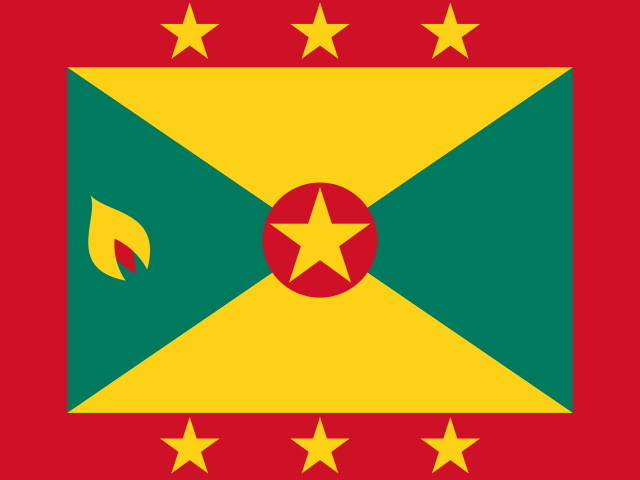 Grenada
Citizenship
Grenada
Citizenship
At a glance
Grenada uses different citizenship procedures after residence, government service, or marriage. Identify the applicant class first, then apply that class's exact time, English, conduct, intention, evidence, and oath rules.
- Ordinary naturalization
- Final 12 months plus 5 aggregate years in the preceding 7
- Commonwealth or Irish registration
- Usually 5 immediately preceding years of residence or government service
- Spouse registration
- Separate application route; no 3-year marriage rule in the cited law
- Decision process
- Application, records, route-specific checks, and any required oath
- What it gives
- Successful naturalization or registration makes the applicant a Grenadian citizen.
- Main limit
- It is not automatic citizenship after seven years.
Summary
Grenada does not use one universal “seven years, then citizenship” rule. Its Citizenship Act and Constitution contain different procedures for different applicants:
- ordinary naturalization for a person treated as an alien or British protected person;
- registration for a Commonwealth citizen or citizen of Ireland; and
- registration for the spouse of a Grenadian citizen.
The correct class must be identified before counting residence. Ordinary naturalization normally requires residence throughout the 12 months immediately before the application plus at least five aggregate years of residence or qualifying Grenada government service during the preceding seven years. Commonwealth or Irish registration normally requires five immediately preceding years of residence, Grenada government service, or a permitted combination. A citizen's spouse uses a separate registration rule; the Constitution and Citizenship Act reviewed here do not impose the three-year marriage period previously stated in this guide.
None of these routes should be described as citizenship appearing automatically when a calendar threshold is reached. The applicant must use the correct procedure, prove the legal requirements, complete any applicable oath, and receive the official registration or naturalization decision and documentation.
Eligibility
For ordinary naturalization, section 7 and the First Schedule of the Citizenship Act set out the main conditions. The applicant must be of full age and capacity, be of good character, have adequate knowledge of English, and intend—if naturalized—to reside in Grenada or enter or continue qualifying service under the Government of Grenada or an approved international organization or association. An oath of allegiance is part of the statutory structure.
The ordinary time pattern is specific:
- residence in Grenada throughout the 12 months immediately before applying; and
- during the seven years immediately before that 12-month period, at least five aggregate years of residence in Grenada, qualifying government service, or a permitted combination.
This is often described loosely as seven years, but that can mislead. The statute asks for a final 12-month block and five aggregate years within an earlier seven-year window. The Minister has limited powers under the Schedule to accept a different 12-month period ending not more than six months before the application and to treat certain earlier residence or service in the manner the Schedule permits. Those are discretionary adjustments, not a general right to ignore absences or status gaps.
For registration as a Commonwealth citizen or citizen of Ireland, section 5 uses a different test. The applicant must be of full age and capacity, be of good character, have adequate English, and normally have resided in Grenada, served under the Government of Grenada, or combined the two throughout the five years immediately before applying. The applicant must also have the required intention to reside in Grenada or enter or continue the qualifying service. The Act lets the Minister accept a shorter residence or service period in special circumstances, but not less than 12 months. Meeting 12 months does not create an entitlement to that exception.
For a spouse of a Grenadian citizen, section 98 of the Constitution creates a separate right to apply for registration, subject to the oath where the constitutional text requires it and to exceptions or qualifications prescribed for national security or public policy. Section 5(3) of the Citizenship Act also addresses spouse registration. The reviewed provisions do not say the marriage must first last three years or that the spouse must complete the ordinary residence periods. The legal marriage and the citizen spouse's status must be proved, and the current form, checks, and any oath still have to be completed.
The Citizenship Act's older constitutional language and classification terms can be difficult to map to a modern applicant, particularly for people with multiple nationalities or an unusual British status. Do not choose “Commonwealth” merely because a country was historically connected to Britain. Confirm the applicant's current nationality class and the procedure the Ministry will accept.
Residence must also be proved as the law requires. Physical presence, immigration permission, and government-service evidence may not always be identical concepts. Tourist visits or ownership of a Grenadian home should not be assumed to count as qualifying residence. Keep passports, entry and exit records, residence permissions, work or service records, leases, bills, tax records, and other official evidence that allows the authority to reconstruct the relevant period.
What This Route Allows
Successful naturalization or registration makes the applicant a Grenadian citizen. The person can obtain the official certificate or registration evidence and then apply for a Grenadian passport. Citizenship allows residence and work in Grenada without a foreign national's immigration or work permit and brings the rights and obligations Grenadian law attaches to citizenship.
The route gives long-term residents and qualifying spouses a citizenship path without using the citizenship-by-investment program. Government service may also count within the statutory residence or service formulas where it fits the Act.
A new citizen's children may have their own status or registration possibilities, but approval of the parent does not automatically resolve every child's case. The child's birth date, place of birth, the parent's effective citizenship date and basis, and Grenada's constitutional descent restriction all matter.
What This Route Is Not
It is not automatic citizenship after seven years. It is also inaccurate to describe the ordinary formula as “five of the last eight years plus a final year” without preserving the statute's exact sequence: the five aggregate years sit within the seven years before the final 12-month period.
The Commonwealth or Irish route is not the ordinary naturalization formula with a different label. It has its own five-year immediately preceding period and a limited shorter-period discretion. Commonwealth nationality alone is not enough.
The spouse route is not ordinary naturalization and, in the cited Constitution and Act, is not conditioned on an invented three-year marriage period. It is nevertheless an application route—not a claim that marriage instantly produces a passport. The applicant must prove a legally recognized marriage and the spouse's citizenship and satisfy the current official procedure.
This route is not citizenship by investment, and buying property or making a donation does not substitute for residence or registration requirements. It also does not guarantee that every absence counts, that every immigration status qualifies, or that good character and English will be accepted without assessment.
Citizenship does not automatically establish tax residence, remove tax or nationality obligations elsewhere, guarantee a passport without the required records, or promise entry to another country. Those issues require separate advice.
Next Steps
- Identify the correct class before counting time: ordinary naturalization, Commonwealth or Irish registration, or spouse registration. Use nationality records and the current Government forms rather than an informal label.
- Obtain the current form and checklist from Home Affairs. Ask for written confirmation of the legal class if multiple nationalities, British protected-person history, government service, or a citizen spouse creates uncertainty.
- For ordinary naturalization, prepare a timeline showing the final 12 months and the preceding seven-year window, marking every absence and each period of qualifying residence or service.
- For Commonwealth or Irish registration, map the five years immediately before filing. If requesting the special shorter-period discretion, document why the case is special and do not assume approval.
- For spouse registration, obtain the marriage record, the spouse's Grenadian birth or citizenship evidence, identity records, and any documents needed to address prior marriages, name changes, or recognition of a foreign marriage.
- Assemble passports, immigration permissions, entry and exit history, service records, police and character material, English evidence where required, civil records, photographs, legalizations, and translations.
- Check every answer against the records before filing. Explain gaps or inconsistencies rather than omitting them.
- Submit through the official channel, attend any interview, respond to further evidence requests, and complete the oath where applicable.
- After approval, secure the naturalization or registration evidence before applying for a passport. Analyze each child's position separately under the birth, descent, or minor-registration rules.
Grenada
Grenada Citizenship by Birth
A person born in Grenada on or after independence on 7 February 1974 is generally a citizen at birth, subject to the Constitution's narrow foreign-envoy and enemy-occupation…
Grenada
Grenada Citizenship by Descent
For a person born outside Grenada on or after 7 February 1974, citizenship at birth generally requires a mother or father who was a Grenadian citizen at that time on a basis…
Grenada
Grenada Citizenship Investment: Donation
Grenada's citizenship-by-investment program has a non-refundable National Transformation Fund contribution starting at USD $235,000 for a main applicant and up to three…
Sources
- Government of Grenada — Constitution — official Constitution, including section 98 on spouse registration.
- Laws of Grenada — Citizenship Act, Chapter 54 — official sections 5 and 7, the First Schedule, oaths, and administrative provisions.
- Laws of Grenada — Citizenship Act Portal — official legislation catalog entry and download context.
- Government of Grenada — Home Affairs Forms — official forms for Commonwealth, parent, grandchild, spouse, naturalization, and minor applications.
- Embassy of Grenada — Frequently Asked Questions — official consular contact and citizenship/passport context.