
St. Kitts Citizenship Investment: Donation
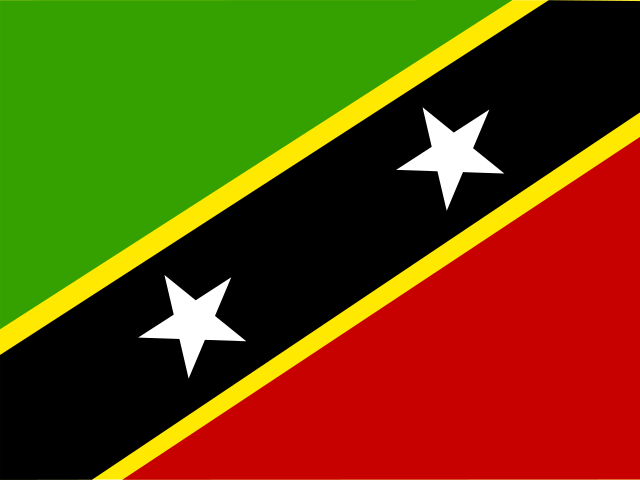 Saint Kitts and Nevis
Citizenship
Saint Kitts and Nevis
Citizenship
At a glance
The Sustainable Island State Contribution is a non-refundable citizenship-program payment. It starts at USD $250,000 for a main applicant or a family of up to four, and approval also requires an Authorised Agent, due diligence, an interview, biometric enrollment, and payment of all applicable fees.
- Type
- Citizenship by investment
- Investment fit
- Investors and qualifying family members
- Core requirements
- Contribution, lawful source of funds, due diligence, interview, and biometrics
- What to know
- The contribution is non-refundable and all applications require official approval
- Minimum investment
- USD $250,000
- Investment choices
- Sustainable Island State Contribution
Summary
The Sustainable Island State Contribution (SISC) is the non-refundable contribution option in the Saint Kitts and Nevis Citizenship Programme. The current minimum is USD $250,000 for one main applicant or a family of up to four. A larger family pays an additional USD $25,000 for each extra dependent under 18 and USD $50,000 for each extra dependent aged 18 or older.
Paying the contribution does not buy automatic citizenship. The main applicant must be at least 18, apply through an Authorised Agent, provide the required records, pass the Citizenship Unit's due-diligence review, complete an interview, and receive approval in principle. New applications submitted from 14 April 2026 also include mandatory biometric enrollment. The contribution is made as part of the approval process, and other fees and professional costs are separate.
The current SISC page says there is no requirement to live in or travel to Saint Kitts and Nevis as part of this option. That does not remove the in-person biometric requirement: enrollment must take place at an officially designated collection center, which may be outside the Federation. The Citizenship Unit has also announced a transition toward a future "genuine link" framework. Because the operative SISC page does not yet publish a specific residence-day formula, obtain written confirmation of the rules that will apply to a new filing before committing funds.
Eligibility
Main applicant
The main applicant must:
- be at least 18 years old;
- agree to make the qualifying contribution;
- meet the application, financial, and due-diligence requirements;
- apply through an Authorised Agent on the Citizenship Unit's current official list; and
- provide complete and truthful information and documents.
The Citizenship Unit's current eligibility page says a person is not eligible if the person has been denied citizenship by another country; has an unresolved visa refusal from a country to which Saint Kitts and Nevis citizens have visa-free access; has a criminal record; is the subject of a criminal investigation; was declared bankrupt within the ten years before applying; or is involved in activity likely to bring Saint Kitts and Nevis into disrepute. It currently says applications are not accepted from citizens of Afghanistan, Belarus, Iran, Iraq, North Korea, or Russia. Check that page again immediately before filing because nationality policies can change.
Contribution and additional costs
The current SISC amounts are:
- USD $250,000 for a main applicant or a family of up to four;
- USD $25,000 for each additional dependent under 18; and
- USD $50,000 for each additional dependent aged 18 or older.
The current due-diligence fee is USD $10,000 for the main applicant and USD $7,500 for each dependent aged 16 or older. Biometric-enrollment and passport-modernization fees, document costs, translations, legalization, and Authorised Agent charges can also apply. Ask for a written, family-specific total rather than treating USD $250,000 as the complete price.
The Citizenship Unit requires proof of funds. Be prepared to explain and document how the contribution and all related costs were earned, held, and transferred. The application process page lists proof of funds, identity documents, police clearance, and other supporting records among the required material.
Family members
The current official eligibility page lists these possible dependents:
- the main applicant's spouse;
- a child under 18;
- a child aged 18 to 30 who attends a recognized secondary or tertiary institution full time and is fully supported by the main applicant;
- a child aged 18 or older who is physically or mentally challenged; and
- a parent of the main applicant or spouse who is at least 55, lives with the main applicant, and is fully supported by the main applicant.
Do not assume that a relative qualifies merely because the relative is financially dependent. The Citizenship Unit decides whether the relationship, age, education, living arrangement, and support evidence meet the current definition.
Interview and biometrics
Every main applicant must attend an interview conducted by the Citizenship Unit, its officials, or an independent firm it appoints. The interview may be virtual, in person in the Federation, or at another location approved by the Unit. A dependent aged 16 or older may also be interviewed if the Unit considers it necessary.
Biometric enrollment is a separate current requirement. For new Citizenship Programme applications submitted from 14 April 2026, it is mandatory after approval in principle. The official biometric page says the requirement applies to dependents and children under age-appropriate standards. Enrollment must be booked through the government process and completed at a designated collection center.
EU visa-free travel is under policy scrutiny
EU visa-free travel is under policy scrutiny
St Kitts and Nevis citizenship still carries the current EU short-stay treatment, but the Commission is monitoring its investor-citizenship program under a mechanism that can suspend visa-free access. No suspension has been announced.
Timing: The revised EU mechanism has applied since 31 December 2025, but it does not automatically suspend travel. The Commission has not announced a suspension for Antigua and Barbuda, Dominica, Grenada, St Kitts and Nevis or Saint Lucia. It continues annual monitoring and country engagement.
Current pathway rules still apply.
The contribution option may gain residence and continuing-engagement duties
The contribution option may gain residence and continuing-engagement duties
The Citizenship Unit says it intends to move away from a purely contribution-based model and require a substantive connection to the Federation. No numeric residence rule or filing-date transition has been published, so the current contribution option remains available under its live rules for now.
Timing: The Citizenship Unit has not published a commencement date, a minimum number of residence days or final transition rules. Its current application pages still describe the existing contribution and real-estate options, so applicants should not assume either that the announced framework already applies or that current no-residence language will remain unchanged.
Current pathway rules still apply.
What This Route Allows
If the application is approved and all program steps are completed, the applicant receives Saint Kitts and Nevis citizenship and a citizenship certificate. A passport is a separate document and must be applied for after the citizenship and biometric steps are completed.
Citizenship permits the person to live and work in Saint Kitts and Nevis without a separate immigration permit. The Citizenship Unit also states that dual citizenship is allowed, but an applicant should check whether any other country whose citizenship they hold restricts multiple citizenship.
Citizenship does not guarantee admission to another country. Visa-free arrangements, electronic travel-authorization rules, passport standards, and border decisions can change.
What This Route Is Not
This is not a refundable deposit or an investment account. The SISC contribution is non-refundable, and due-diligence and professional costs may also be non-refundable even if the application is refused.
It is not a guaranteed approval. Meeting the contribution amount does not replace the background review, source-of-funds checks, interview, biometrics, document review, or the Citizenship Unit's decision.
It is not a direct application route. The Citizenship Unit says applicants cannot file directly and must use an Authorised Agent from the official list.
Citizenship is not the same as tax residence. Obtaining citizenship does not by itself decide where a person is tax resident or what taxes apply to income, assets, or transactions in another country.
Finally, "no mandatory residence" on the current SISC option page should not be read as a promise that program policy will never change. The Unit has publicly announced a genuine-link transition but has not set out a numeric residence rule on the current SISC page. Confirm the filing-date rules in writing.
Next Steps
- Check the current SISC and eligibility pages for the contribution, dependent, nationality, interview, biometric, and genuine-link rules in force on the planned filing date.
- Choose an Authorised Agent only from the Citizenship Unit's official list. Applicants cannot submit directly to the Unit.
- Ask the agent for a written calculation covering the contribution, due diligence, biometrics, passport steps, documents, translations, legalization, and all professional charges for the whole family.
- Complete a confidential eligibility review before paying non-refundable costs. Disclose visa and citizenship refusals, criminal or investigation history, bankruptcy, all citizenships, and any other issue requested by the official forms.
- Build the source-of-funds file. Keep bank records, employment or business evidence, tax and transaction records, and a clear explanation of how each payment will be made.
- Submit the application through the Authorised Agent and complete the required interview. Do not describe approval in principle as final citizenship.
- After approval in principle, follow the Unit's current instructions for biometric enrollment, the contribution, and any remaining fees. Use only official payment and booking channels.
- After the citizenship certificate is issued, complete the separate passport process and keep evidence of every continuing program obligation.
Saint Kitts and Nevis
St. Kitts Citizenship Investment: Real Estate
This route is for an adult who can buy qualifying real estate under the Citizenship Programme. Approved developer property and designated private condominiums or shares start…
 Turkey
Turkish Citizenship by Investment
Türkiye's exceptional citizenship route is for applicants who complete one of the investment or job-creation options set by the government and obtain the required eligibility…
 Grenada
Grenada Citizenship Investment: Donation
Grenada's citizenship-by-investment program has a non-refundable National Transformation Fund contribution starting at USD $235,000 for a main applicant and up to three…
Sources
- Citizenship Unit — Sustainable Island State Contribution
- Citizenship Unit — Eligibility Criteria
- Citizenship Unit — Application Process
- Citizenship Unit — Authorised Agents List
- Citizenship Unit — Biometric Enrolment and Passport Modernisation
- Citizenship Unit — 2026 genuine-link announcement
- Saint Christopher and Nevis Citizenship by Substantial Investment Regulations, 2023
- Saint Christopher and Nevis Citizenship by Substantial Investment (Amendment) Regulations, 2024